


The result: quality improvements that are built into the system, fully traceable, and auditable - not just claimed.

Through risk-based credibility assessment per context of use: define the question and context, assess model influence and decision consequence, scale the evidence to that risk, execute, document deviations, and judge adequacy - the same logic as FDA draft guidance and CSA principles.
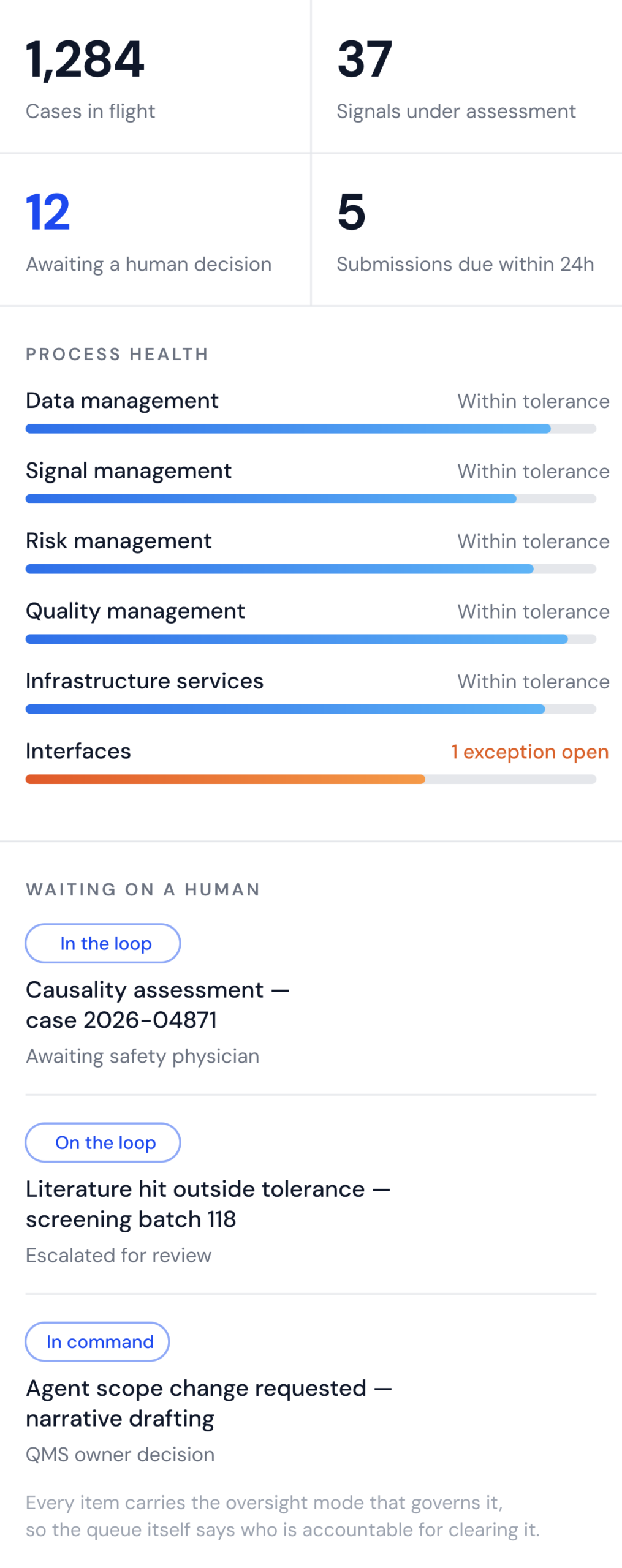
An oversight mode where high-volume work runs autonomously while qualified humans monitor quality signals, review sampled output and intervene on flagged exceptions - one of the humans-first models (HIC, HITL, HOTL) described by CIOMS WG XIV.
No. Credible for one context of use does not automatically mean credible for another. Each workflow carries its own assessment, and any workflow can be halted, narrowed or re-qualified at any moment.
Named people are always accountable when an agent errs: the QPPV and deputy, the QMS owner and named process owners. Every action, human or agent, is captured in a single end-to-end audit trail.



Hvezdova 1716/2b, 140 00 Prague 4, Czech Republic
1500 District Avenue, Burlington, MA, United States